
In the field of education, every teaching-learning activity is driven by certain objectives. These objectives define what changes or outcomes are expected in the learner after successful completion of an instructional process. They serve as a compass for teachers, guiding both the planning of lessons and the evaluation of learning outcomes.
A teaching objective is thus an intended outcome of instruction — what learners are expected to know, understand, or do after a lesson — rather than the process itself. A well-defined objective is specific, measurable, attainable, realistic, and time-bound (SMART).
Objectives of Teaching (UGC NET Paper 1)
Introduction: Meaning of Objectives of Teaching
The term objective refers to a clearly defined intended learning outcome that a teacher expects learners to achieve after instruction. In education, objectives act as a guiding force for the entire teaching–learning process.
👉 An objective describes the end result of instruction, not the method used to achieve it.
In simple terms:
Teaching objectives answer the question – “What change should occur in the learner after teaching?”
A good teaching objective should be:
- Specific – Clearly stated and focused
- Outcome-based – Emphasizes learner behavior, not teacher activity
- Measurable – Can be assessed or evaluated
- Learner-centred – Focused on student achievement
For example:
❌ “To teach the concept of motivation”
✅ “The learner will be able to explain different theories of motivation”
Integration of Teaching and Learning Objectives
Teaching objectives and learning objectives are not separate entities. They must integrate at the end of instruction, meaning:
- Teaching is effective only when learning objectives are achieved
- Learning outcomes validate the success of teaching
Hence, objectives act as a bridge between:
- Curriculum goals
- Teaching strategies
- Learning experiences
- Evaluation and assessment
Classification of Instructional Objectives
There are two most important and frequently asked classifications in UGC NET:
- Bloom’s Classification of Instructional Objectives
- Gagné and Briggs’ Classification of Learning Outcomes
I. Bloom’s Classification of Teaching and Instructional Objectives
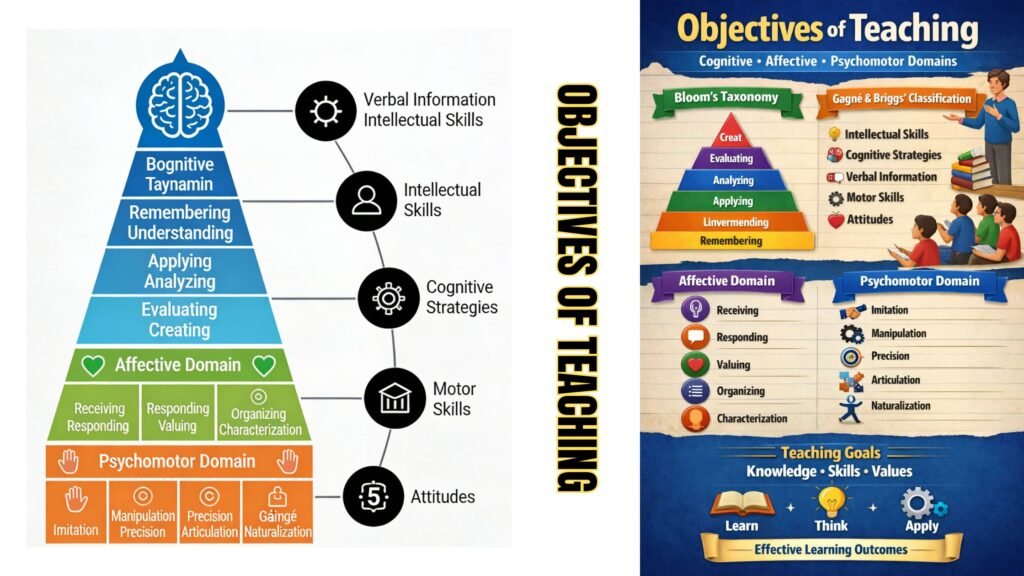
Bloom’s taxonomy is the most widely accepted framework for classifying educational objectives. It divides objectives into three major domains:
- Cognitive Domain
- Affective Domain
- Psychomotor Domain
This classification was proposed by Benjamin Bloom.
1. Cognitive Domain (Knowledge / Intellectual Domain)
The cognitive domain deals with the development of intellectual abilities, such as:
- Thinking
- Reasoning
- Understanding
- Problem-solving
📌 It is considered the core learning domain because:
- Affective and psychomotor learning depend on cognition
- Knowledge precedes attitude and skill development
Bloom initially proposed six hierarchical levels within the cognitive domain, each representing a deeper level of understanding:
| Original Bloom’s Levels | Revised Bloom’s Levels (Anderson & Krathwohl, 2001) | Description / Example |
|---|---|---|
| Knowledge | Remembering | Recall or recognition of facts, terms, or concepts. |
| Comprehension | Understanding | Explain ideas, interpret material in one’s own words. |
| Application | Applying | Use knowledge in new situations, problem-solving. |
| Analysis | Analysing | Break information into parts to see relationships or patterns. |
| Synthesis | Creating | Combine elements to form new structures or ideas. |
| Evaluation | Evaluating | Make judgments about the value or use of material. |
Original Bloom’s Taxonomy – Six Levels
(a) Knowledge
- Involves recall and recognition of facts
- Keywords: define, list, name, identify
Example:
👉 Define reinforcement.
(b) Comprehension
- Understanding the meaning of information
- Keywords: explain, summarize, interpret
Example:
👉 Explain classical conditioning in your own words.
(c) Application
- Using knowledge in real or practical situations
- Keywords: apply, demonstrate, solve
Example:
👉 Apply the law of effect in classroom management.
(d) Analysis
- Breaking material into components to understand relationships
- Keywords: analyze, differentiate, compare
Example:
👉 Distinguish between formative and summative evaluation.
(e) Synthesis
- Combining elements to form a new structure
- Keywords: design, formulate, construct
Example:
👉 Design a learner-centred curriculum.
(f) Evaluation
- Making judgements based on criteria
- Keywords: evaluate, justify, critique
Example:
👉 Evaluate the effectiveness of online learning.
Example for classroom application:
- Remembering: Recall definitions of democracy.
- Understanding: Explain the concept of democracy in your own words.
- Applying: Illustrate democratic principles through examples from India.
- Analysing: Compare democracy with authoritarian systems.
- Evaluating: Judge the effectiveness of democratic governance.
- Creating: Design a model of student governance following democratic principles.
Hence, the cognitive objectives focus on the development of reasoning, logic, and knowledge organization.
Revised Bloom’s Taxonomy (Anderson & Krathwohl)
Bloom’s taxonomy was later revised by Lorin Anderson and David Krathwohl.
Major Changes
- Nouns → Action verbs
- Synthesis replaced by Creating
- Evaluation placed before Creating
Revised Six Levels
- Remembering – Recall facts
- Understanding – Explain meaning
- Applying – Use knowledge
- Analysing – Break into parts
- Evaluating – Judge value
- Creating – Produce new ideas
📌 UGC NET frequently asks:
- Difference between original and revised Bloom’s taxonomy
- Order of levels
- Action verbs related to each level
2. Affective Domain (Attitude, Values & Emotions)
Human beings are not only rational but also emotional and social.
The affective domain focuses on:
- Attitudes
- Values
- Interests
- Motivation
- Emotional development
It deals with how learners feel about learning.
The affective domain deals with feelings, emotions, attitudes, motivation, and values. It emphasizes the emotional growth of learners so they become sensitive and responsible members of society.
Key features:
- Development of desirable attitudes and interests.
- Adjustment to social and moral values.
- Cultivation of emotional intelligence (as explained by Daniel Goleman, 1995).
Five hierarchical levels of affective learning:
- Receiving: Willingness to listen and pay attention.
- Responding: Active participation in class or group discussions.
- Valuing: Showing commitment or preference for particular ideas or behaviours.
- Organizing: Integrating new values into one’s belief system.
- Characterization: Consistently acting according to internalized values.
Example:
A student progresses from merely listening to lessons on environmental conservation (Receiving), to participating in a tree plantation drive (Responding), to valuing ecological balance (Valuing), then organizing school campaigns (Organizing), and finally, adopting eco-friendly habits as a lifestyle (Characterization).
The affective objectives are gradual and long-term — they cannot be achieved in a single lesson but develop over time through experiences and reflective learning.
Importance of Affective Domain
- Helps in social adjustment
- Develops democratic values
- Encourages cooperation, tolerance, empathy
- Shapes personality and character
Levels of Affective Domain
(a) Receiving
- Willingness to listen
- Awareness and attention
Example:
👉 Listening attentively to a lecture.
(b) Responding
- Active participation
- Reacting to learning
Example:
👉 Asking questions in class.
(c) Valuing
- Showing commitment or belief
Example:
👉 Valuing honesty and discipline.
(d) Organizing
- Integrating values into a system
Example:
👉 Prioritizing ethical principles in decision-making.
(e) Characterization
- Values become part of personality
Example:
👉 Living a disciplined and socially responsible life.
Time Factor in Affective Learning
Affective objectives:
- Cannot be achieved instantly
- Require long-term exposure
- Develop gradually through multiple learning experiences
Emotional Intelligence and Affective Learning
According to Daniel Goleman, Emotional Intelligence (EI) refers to the ability to:
- Understand emotions
- Regulate emotions
- Use emotions constructively
📌 Important psychological insight:
- Emotional brain often reacts before rational brain
- Education must equip learners with knowledge to control emotions logically
Educational Implication
👉 Cognitive learning and affective learning must go together
Affective Disorders (UGC NET Perspective)
- Affective flattening – Reduced emotional expression (seen in schizophrenia)
- Related disorders:
- Catatonia – Motor immobility
- Alogia – Poverty of speech
📌 NET exam sometimes links psychology concepts with education.
3. Psychomotor Domain (Skill Development)
The psychomotor domain is concerned with:
- Physical movement
- Motor skills
- Technical and manual abilities
Commonly associated with:
- Laboratory work
- Sports
- Vocational and technical education
This domain is related to the development of physical skills, coordination, and motor abilities that involve muscular and nervous system integration. It is highly relevant in technical, vocational, science, and art education.
Five levels of psychomotor objectives (as per Simpson and Harrow):
- Imitation: Observing and copying the demonstration of a skill.
- Manipulation: Practicing and experimenting under guidance.
- Precision: Performing the skill with accuracy and control.
- Articulation: Coordinating multiple skills to produce efficient performance.
- Naturalization: Mastery level where skills become automatic, creative, and adaptable.
Example:
In computer education —
- Imitation: Following teacher’s steps to type.
- Manipulation: Typing letters with practice.
- Precision: Typing error-free text with proper hand movement.
- Articulation: Using multiple software tools efficiently.
- Naturalization: Developing self-taught shortcuts or customizing the workspace.
Key point: Learning is rarely isolated. The cognitive, affective, and psychomotor domains operate together during instruction — for example, programming (cognitive), enthusiasm for coding (affective), and typing skill (psychomotor) all interact.
Levels of Psychomotor Domain
(a) Imitation
- Copying actions after demonstration
Example:
👉 Following a lab experiment shown by teacher.
(b) Manipulation
- Performing actions with guidance
Example:
👉 Handling laboratory equipment.
(c) Precision
- Accuracy and refinement
Example:
👉 Conducting experiments without error.
(d) Articulation
- Coordination of multiple skills
Example:
👉 Efficient teaching using multiple teaching aids.
(e) Naturalization
- Skill becomes automatic
Example:
👉 Expert teacher adapting methods effortlessly.
Interrelationship of the Three Domains
- Learning occurs through cognitive, affective, and psychomotor channels simultaneously
- These domains are not mutually exclusive
- Separation is done only for analytical and evaluation purposes
📌 Key UGC NET Insight:
Cognitive and affective learning occur with the same content at the same time.
II. Gagné and Briggs’ Classification of Instructional Objectives
Proposed by Robert Gagné and Leslie Briggs, this classification focuses on learning outcomes.
Five Categories
1. Intellectual Skills
- Concept learning
- Rule learning
- Problem-solving
2. Cognitive Strategies
- Learning how to learn
- Memory techniques
- Thinking strategies
3. Verbal Information
- Organized knowledge
- Facts, principles, theories
4. Motor Skills
- Physical actions requiring coordination
5. Attitudes
- Internal states influencing behaviour
📌 Exam Tip:
Bloom = Domains of objectives
Gagné = Types of learning outcomes
Hierarchy of Formulation of Objectives
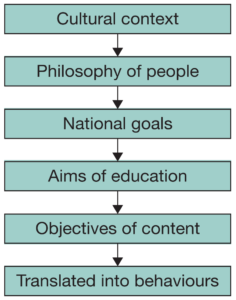
- Cultural Context
- Philosophy of People
- National Goals
- Aims of Education
- Objectives of Content
- Translated into Behaviour
This hierarchy ensures that classroom teaching aligns with national and societal needs.
Conclusion (Exam-Ready Summary)
- Objectives define the direction of teaching
- Bloom’s taxonomy explains how learning occurs
- Affective and psychomotor domains are equally important
- Gagné and Briggs focus on learning outcomes
- Effective education integrates knowledge, skills, and values
👉 For UGC NET Paper 1, questions are commonly asked on:
- Bloom’s domains and levels
- Revised taxonomy order
- Affective domain characteristics
- Difference between Bloom and Gagné
- Application-based MCQs
)