Objectives of Teaching: Complete Conceptual Guide for UGC NET Paper 1
Teaching–Learning is the core unit of UGC NET Paper 1. Almost 25–30% questions are directly or indirectly asked from objectives of teaching, levels of teaching, teaching–learning paradigms, Bloom’s taxonomy, curriculum, domains of learning, and teaching philosophies.
🔑 What Are Objectives of Teaching?
Teaching objectives describe the intended learning outcomes of instruction—what the learner should be able to know, understand, or do after teaching.
Characteristics of Good Instructional Objectives
A good teaching objective must be:
- ✔ Specific
- ✔ Observable
- ✔ Measurable
- ✔ Learner-centred
- ✔ Outcome-based
👉 UGC NET Point: Objectives are written for students, not teachers.
🔄 Teaching–Learning Paradigms
There are two basic paradigms in classroom teaching:
1️⃣ Instructional Paradigm
- Teacher-centred
- Focus on content delivery
- Emphasizes how teaching is done
2️⃣ Learning Paradigm
- Learner-centred
- Focus on learning outcomes
- Emphasizes what students learn
📌 Exam Answer:
✔ Both Learning and Instructional paradigms are basic paradigms
👩🏫 Prime Requirement of a Good Teacher
The most essential requirement is:
✅ Genuine interest in teaching
Other important components:
- Subject knowledge
- Teaching skills
- Expression ability
👉 Without interest, other skills lose effectiveness.
🎨 Is Teaching an Art or Science?
Teaching is:
- ❌ Not just an art
- ❌ Not based on birth alone
- ❌ Not untrainable
✔ Teaching is:
- An art
- A science
- A trainable professional skill
📌 NET Insight:
Teaching is learned + practiced + refined
🎯 Most Desirable Skill of a Teacher
✔ Ability to make students understand
Teaching success is measured not by syllabus coverage, but by student comprehension.
🧠 Levels of Teaching (Very Important for UGC NET)
Teaching operates at three progressive levels: memory level (Herbart), focusing on rote recall and fact retention; understanding level (Morrison), emphasizing comprehension and application; and reflective level (Hunt), promoting critical thinking and problem-solving. The correct sequence follows memory → understanding → reflective, building foundational knowledge before higher-order analysis. Memory level prioritizes systematic presentation for quick reproduction and concept sequencing, not critical thinking.
✅ Three Levels of Teaching
- Memory Level
- Understanding Level
- Reflective Level
Correct Sequence:
👉 Memory → Understanding → Reflective
🔹 1. Memory Level of Teaching
Focus: Recall & reproduction of facts
Characteristics:
- Rote learning
- Systematic presentation
- Quick reproduction
- Teacher-centred
Emphasis on:
- Concept sequencing
- Organized ideas
- Recall-based learning
🔹 2. Understanding Level of Teaching
Focus: Meaning and relationships
Characteristics:
- Explanation
- Interpretation
- Cause–effect relationships
- Student participation
🔹 3. Reflective Level of Teaching
Focus: Critical & creative thinking
Characteristics:
- Problem-solving
- Analysis & evaluation
- Open classroom environment
- Independent thinking
| Level | Main Proponent | Key Focus | Classroom Environment |
|---|---|---|---|
| Memory | Herbart | Recall facts | Structured, teacher-led |
| Understanding | Morrison | Interpret and apply | Interactive examples |
| Reflective | Hunt | Problem-solving, independence | Open and independent |
📌 NET Tip:
✔ Open and independent classroom is required only at reflective level
🔬 Independent & Dependent Variables in Teaching
Teachers act as the independent variable in the teaching-learning process, manipulating methods and environment to influence outcomes, while students serve as the dependent variable. In dynamic settings, this confirms teachers drive change, with students responding accordingly. Institutions or parents function as intervening factors
Traditional View:
- Teacher → Independent variable
- Student → Dependent variable
Dynamic Teaching Environment:
- ✔ Teacher = Independent variable
- ✔ Student = Dependent variable
🧪 Teaching Methods: Analytical & Synthetic
Best Practice:
✔ Analytical + Synthetic Method
- Analysis: Breaks complex ideas
- Synthesis: Combines ideas meaningfully
📌 Teachers must use both, not only one.
📐 Teaching Maxims & Their Proponents
| Teaching Maxim | Proponent |
|---|---|
| From whole to part | Gestalt Psychologists |
| Self-study | Dalton Plan |
| Training of senses | Montessori & Fröbel |
Common Teaching Maxims:
- From concrete to abstract
- From known to unknown
- From psychological to logical
- Follow nature
✔ All are valid teaching maxims
📊 Effectiveness of Teaching
Teaching effectiveness is judged by:
✔ Learning outcomes of students
❌ Not by:
- Course coverage
- Teaching aids
- Teacher activity
📘 What Is Curriculum?
Curriculum is:
The organized totality of learning experiences provided by educational institutions to achieve set goals.
It includes:
- Subjects
- Activities
- Projects
- Experiences
- Values
📌 Curriculum is broader than syllabus
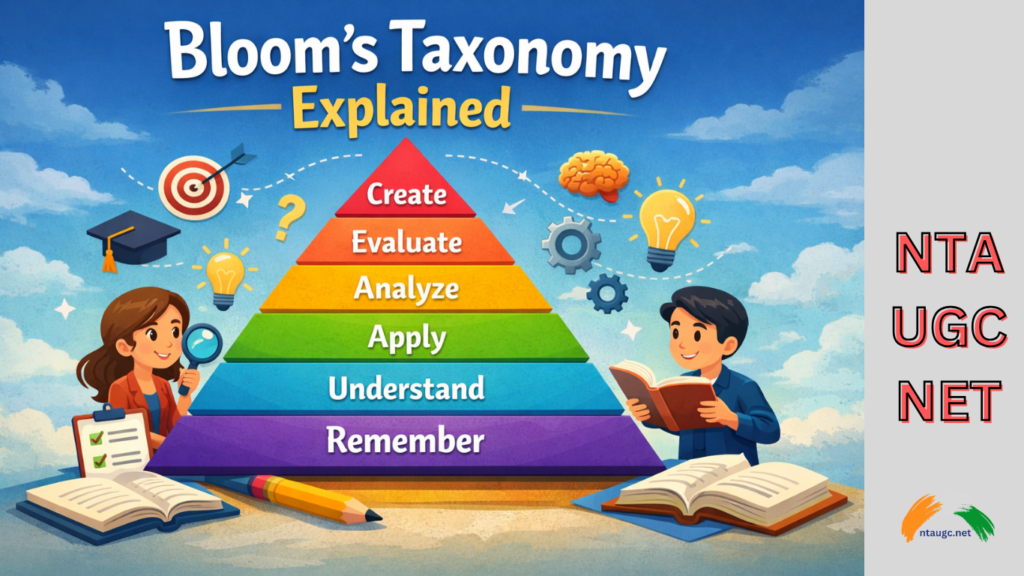
🧩 Bloom’s Taxonomy of Educational Objectives
Proposed by Benjamin S. Bloom
Benjamin Bloom classified the cognitive domain, with levels from knowledge to evaluation (highest). Application involves using prior learning in new situations; analysis breaks down problems. Cognitive affects thoughts; psychomotor covers motor skills like experiments; affective handles attitudes.
- Cognitive example: Describe a topic
- Psychomotor example: Perform an experiment
- Affective: Take responsibility
🧠 Cognitive Domain (Thinking)
- Knowledge
- Comprehension
- Application
- Analysis
- Synthesis
- Evaluation (highest level)
❤️ Affective Domain (Attitudes)
- Values
- Emotions
- Feelings
✋ Psychomotor Domain (Skills)
- Physical & motor skills
- Performing experiments
- Typing, operating tools
🎯 Examples of Learning Domains
| Domain | Example |
|---|---|
| Cognitive | Describe a topic |
| Affective | Taking responsibility |
| Psychomotor | Performing an experiment |
🧑🎓 Pedagogy, Andragogy & Heutagogy
🔹 Pedagogy
- Teacher-directed
- Child learning
🔹 Andragogy
- Self-directed adult learning
🔹 Heutagogy
- Self-determined learning
- Learner autonomy
- Capacity & capability development
📌 UGC NET Favorite Concept
🏫 Authoritarian Level of Teaching
- Teacher-centred
- Controlled classroom
- Limited student autonomy
🧠 Educational Philosophies (Matching Section)
Philosophies shape teaching approaches:
| Concept | Philosophy |
|---|---|
| Learning by doing | Pragmatism |
| Education through environment | Naturalism |
| Truth, beauty & goodness | Idealism |
| World as it is | Realism |
🌱 Integral Education
Propounded by Sri Aurobindo
Focus:
- Physical
- Mental
- Moral
- Spiritual development
🖥️ Role of Teacher in Future
With technology growth, teacher’s role will be:
✔ Guide & facilitator
❌ Not merely information provider
📈 Raising the Standard of Education
Most effective method:
✔ Appointing good teachers
🧠 Skills Required for Modern Teachers
✔ Use of technology
✔ Understanding student needs
✔ Content mastery
🎓 Primary Duty of a Teacher
✔ All-round development of students
- Intellectual
- Moral
- Social
- Emotional
✅ Final Takeaway for UGC NET Aspirants
✔ Teaching is outcome-oriented
✔ Learning effectiveness matters more than content coverage
✔ Reflective teaching is the highest level
✔ Bloom’s taxonomy is non-negotiable for NET
✔ Teacher is a guide, not a dictator